
Why Successful Women Stop Trusting Themselves


There comes a point where many successful women stop asking for help because they've become so accustomed to carrying everything themselves that receiving support begins to feel uncomfortable.
From the outside, they appear:
Confident
Capable.
Independent.
Reliable.
The woman everyone turns to.
What people don't see is how lonely that identity can become.
Somewhere along the way, being strong stopped being a choice and became an expectation. While writing one of the recent chapters of The Rise of Scarlet Rose, I found myself thinking less about the story itself and more about a psychological pattern I see every day in women leaders.
The most capable women often become the least supported. Why? Because they've unintentionally built an identity around never needing anyone else.
That's not confidence. It's often survival.
Psychological Leadership™ begins by asking a different question. Not, "Why am I like this?" But, "What happened that taught me I had to carry everything alone?"
Competence Can Become a Survival Strategy

Many women are praised from a young age for:
Being mature.
Being dependable.
Being the one who keeps everything together.
Being responsible.
Those qualities become part of their identity.
Over time, asking for help begins to feel uncomfortable because it contradicts the version of themselves they've spent years building.
Without realizing it, competence becomes more than a strength. It becomes protection.
You stop asking for support because you don't want to burden anyone.
You tell yourself you'll figure it out.
You keep performing.
You keep producing.
You keep showing up.
Meanwhile, the emotional weight keeps growing.
This is the Recognize stage of The RISE Method™ and it's about noticing that the pattern isn't simply independence, it's a learned way of staying emotionally safe.
Your Leadership Reflects Your Psychology

Many leadership challenges aren't really leadership challenges. They're psychological patterns expressed through leadership.
If you've learned that your value comes from being dependable, you may struggle to delegate.
If you've learned that mistakes lead to criticism, you may become a perfectionist.
If you've learned that disappointing people threatens your relationships, you may avoid difficult conversations.
If you've learned that asking for help makes you appear weak, you'll continue carrying more than anyone realizes.
These aren't personality flaws. They're adaptations.
One of the core beliefs behind Psychological Leadership™ is that people make sense once you understand what happened to them.
That's why I rarely begin with strategy. I begin with curiosity, because before strategy comes psychology.
What experiences shaped the way you learned to lead?
Why Receiving Support Feels So Uncomfortable
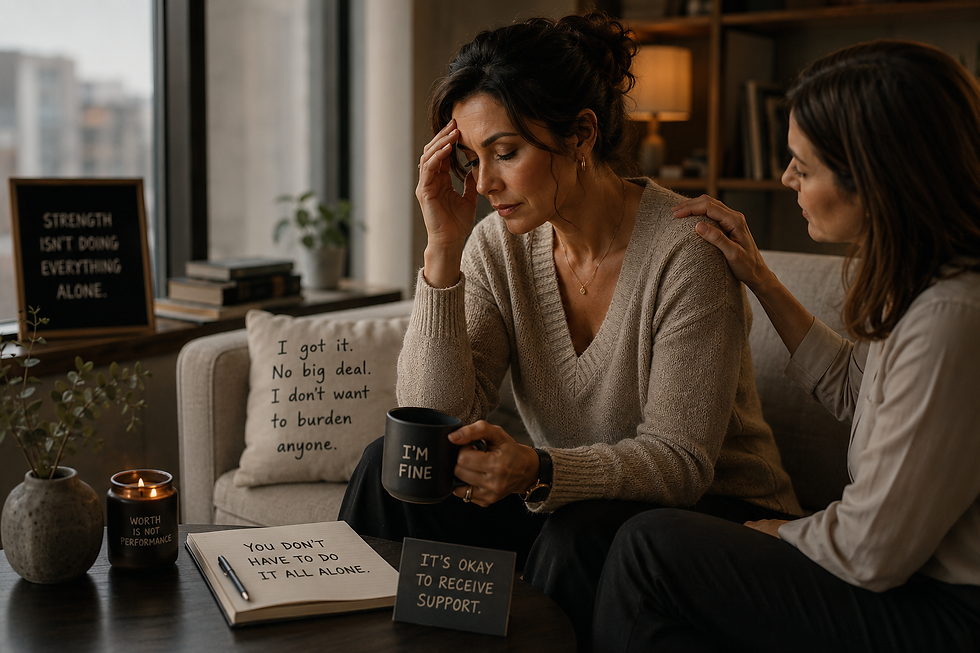
One of the biggest misconceptions about resilience is that resilient people don't need support. In reality, resilient leaders build healthy support systems.
Survival teaches us to rely only on ourselves. Self-leadership teaches us to know when connection makes us stronger.
Many women can offer compassion to everyone else. Yet when it's their turn to receive care, they become uncomfortable.
They minimize their feelings.
They change the subject.
They insist they're fine.
They don't do this because they're dishonest. They do this because vulnerability feels unfamiliar.
Receiving support requires trusting that your worth isn't dependent on how much you can carry.
That's the Interrupt stage of The RISE Method™.
Interrupting the belief that strength means doing everything alone.
Self-Leadership Isn't Self-Sufficiency

One of the biggest misconceptions in leadership is that self-leadership means becoming completely independent.
It doesn't.
Self-leadership means becoming anchored enough in yourself that asking for help no longer threatens your identity. It means recognizing when your nervous system has shifted into protection instead of connection. It means allowing yourself to be supported without believing you've failed.
Healthy leaders don't build lives where they're needed by everyone else. They build lives where they can both give and receive support.
That's what Self-Lead looks like.
Not perfection. Not independence. Balance.
Growth Happens When You Stop Performing Strength

Many women spend years performing strength. They become experts at:
Keeping the peace.
Holding everything together.
Reassuring everyone else.
Eventually, they begin believing that's who they are, but strength isn't measured by how much you can carry. It's measured by how honestly you can lead.
Real confidence isn't proving you don't need people. It's trusting that needing people doesn't diminish your leadership.
That's what Evolve looks like.
You don't become someone new. You stop believing you have to earn your worth by carrying everything alone.
Identity comes before leadership.
Always.
Reflection Questions
As you think about your own leadership, consider:
When was the last time I genuinely asked for support?
What beliefs do I hold about needing other people?
Where did I learn that being capable meant carrying everything alone?
Do I allow others to care for me as easily as I care for them?
What leadership behaviors might actually be survival strategies?
Where is my identity tied to being "the strong one"?
What would change if I believed support strengthened my leadership instead of weakening it?
These questions aren't about becoming more dependent. They're about becoming more aware, because awareness is where Psychological Leadership™ begins.
Before strategy comes psychology.
Before communication comes identity.
Before you can lead anyone else, you have to understand what's been leading you.

Biana Lerman
Your Growth Leader
FAQs
Why do successful women struggle to ask for help?
Many women develop an identity around being dependable, capable, and self-sufficient. Over time, asking for help can begin to feel like failure rather than strength. Psychological Leadership™ helps uncover these patterns so women can lead from self-trust instead of survival.
What is Psychological Leadership™?
Psychological Leadership™ is the practice of understanding the beliefs, conditioning, expectations, and experiences that influence how you communicate, make decisions, build relationships, and lead others. Rather than focusing only on leadership strategies, it begins by understanding the psychology behind them.
How does The RISE Method™ help women leaders?
The RISE Method™ guides women through four stages of transformation:
Recognize the unconscious beliefs and patterns influencing your behavior.
Interrupt the automatic survival responses that no longer serve you.
Self-Lead by making intentional choices aligned with your values and identity.
Evolve into a leader who is no longer driven by old conditioning, but by self-trust and authenticity.
What is the difference between self-leadership and self-sufficiency?
Self-sufficiency is believing you must do everything yourself. Self-leadership is knowing when to rely on your own strength and when allowing support creates better outcomes for yourself and the people you lead.
Why does identity matter in leadership?
Every leadership decision is influenced by how you see yourself. When your identity depends on external validation or being indispensable, leadership becomes reactive. When it's grounded in self-trust, leadership becomes intentional, authentic, and sustainable.
Ready to Lead Without Losing Yourself? If this article resonated with you, the next step may not be learning another leadership strategy. It may be understanding the psychological patterns that have quietly been shaping the way you lead. At Your Growth Leader, we help women leaders understand the beliefs, experiences, and unconscious patterns influencing their leadership, communication, relationships, and identity through Psychological Leadership™, The RISE Method™, executive coaching, workshops, and transformational experiences. The strongest leaders aren't the women who never question themselves. They're the women who understand what has been leading them all along. Once you understand the pattern, you no longer have to keep repeating it. You don't have to become someone new to become a stronger leader. You simply have to stop abandoning the woman you've been all along. Your next chapter doesn't begin when someone finally gives you permission to lead. It begins the moment you stop asking for it. Explore Your RISE Method™ and schedule a RISE Reflection Session to begin your journey.


Comments